

Good morning!
EDITOR’S NOTE
As I announced on Sunday, I’ve decided to adjust my publishing schedule. As of now, I’m publishing the Morning Report on Tuesdays and Fridays. That said, some smart readers have suggested that publishing Mondays, Wednesdays, and Fridays might be a better approach. I’m giving that serious thought.
Here are today’s highlights:
On our latest podcast, a spirited (but respectful) debate about the impact of AI: Are you Team Paul or Team Ted?
The Trump administration wants to make it as difficult as possible for you to get your tariff refund.
When a journalist asked Gemini to set an asking price for the sale of his house, the chatbot set a higher price than the human agents he consulted. And it worked.
Your business is a success. But what will that mean for your kids? A cottage industry has sprung up to offer help.
FRANCHISING
Being a franchisee has quietly made countless Americans wealthy, and AI may make franchise life even more appealing: “Owning a franchise may be the purest distillation of the American dream. Some 95 percent of McDonald’s 14,000 American outlets are operated by franchisees, and the chain has plausibly created more millionaires than any firm in history. ‘We’re not all going to be Steve Jobs or Elon Musk,’ says Matt Haller, who runs the IFA, but many can imagine themselves saving up to have a go at the all-American business of ‘slinging hamburgers.’ The proposition has long appealed to immigrants in particular: around two-thirds of American motels are owned by Indians, many descended from Gujaratis who bought Super 8 and Travelodge franchises in the 1980s.”
“Mr Haller says franchisees now report growing interest from their children in succession plans. That is perhaps unsurprising. A decade ago the path to prosperity for young Americans looked certain: a college education and a white-collar ‘laptop’ job. But rising tuition fees and the emergence of artificial intelligence have prompted renewed interest in the trades and other more pedestrian ways to make a living. In-person businesses—teaching Pilates, cooking food—look like a safer bet now.”
“When Greg Flynn graduated from Stanford Business School in 1994, with the dotcom boom in full swing, his friends chose the obvious career path. But while they ‘were all making PowerPoint presentations … becoming paper millionaires,’ he went off to help a friend open a second restaurant. A few years later, spotting generous financing on offer for would-be franchisees, Mr Flynn bought eight Applebee’s restaurants of his own. He now runs more than 3,000 franchise outlets across seven brands in three countries, and is reportedly worth over $1 billion.”
“Mr Flynn’s is a tale of slow and steady success. So is that of the franchise model, which began spreading across America in the 1950s. Nowadays there are close to 850,000 franchise establishments in the country, run by around 250,000 owners, employing some 9 million people and generating about 3 percent of GDP. As many as one in eight businesses with at least one employee are part of a franchise.” READ MORE
THE 21 HATS PODCAST
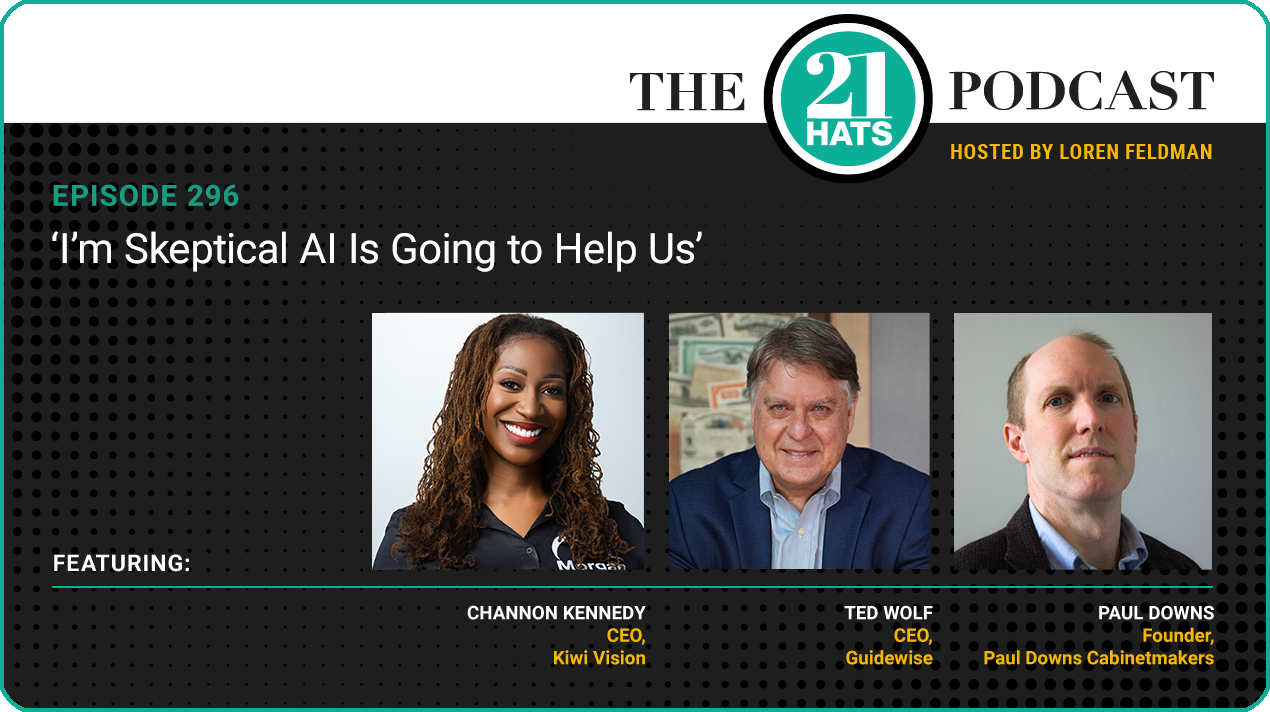
‘I’m Skeptical AI Is Going to Help Us:’ This week we explore some contrasting opinions about artificial intelligence. Paul Downs has serious doubts that AI will ever have a significant impact on his business. Paul, who builds custom conference tables, says his business depends on something AI still lacks: real world experience. While AI can generate impressive images and concepts, he argues that it has no understanding of manufacturing constraints, material properties, production processes, or the capabilities of the people and machines that have to bring an idea to life. “An image of a thing that looks cool is not a design,” Paul says. “A design is a set of information that’s informed by intelligence and experience.”
Ted Wolf, who helps companies implement AI, agrees that AI can’t replace the collective creativity and judgment of skilled people—at least not yet. But he believes Paul may be looking at the problem too broadly. Instead of asking whether AI can design and build custom furniture, Ted suggests breaking the workflow into smaller pieces and experimenting with targeted applications.
The result is a thoughtful debate about one of the biggest questions facing small business owners: Is AI going to change everything, or are there businesses where human expertise will remain irreplaceable?
Plus: Channon Kennedy shares what she learned from participating in a Goldman Sachs program for Black women entrepreneurs. And the owners discuss what debt can—and cannot—do for a business: “Funding does not fix a broken business model. It makes it die faster.”
You can subscribe to the 21 Hats Podcast—brought to you by Grasshopper Bank—wherever you get podcasts.
