

Good morning!
Here are today’s highlights:
In our latest podcast episode, Ted Wolf tells Paul Downs: “You just lowered the value of your company.”
The odds of any new business succeeding are daunting. Leisa Peterson explains why she’s starting one anyway.
There are a lot of different ways to bonus employees. Gene Marks offers some examples.
Only a few slots remain for the 21 Hats Succession Solutions Workshop.
PRICING
American businesses really don’t know what to charge right now: “Melissa Florio and her husband own a company, Ambix Manufacturing, that sells plastic components to power-distribution companies. For months, she expected surging costs to settle down, so she kept her prices low. But in recent months, oil prices have continued to drive up the price of resin, the chemical substance Ambix uses in its products, helping to prompt a change in her outlook. She no longer views the Iran war as a temporary price shock, but rather a long-term barrier to keeping costs stable.”
“These days, when Ambix’s suppliers raise prices, Florio passes the burden on to her customers. She increased prices this summer between 10 percent and 21 percent on all of her products, which include plastic insulators for high-voltage transmission wires. ‘We reached the breaking point,’ she said. ‘We’re not eating that cost any longer.’”
“In rural Pennsylvania, third-generation farmer Jim Barbour isn’t convinced that elevated inflation is here to stay. Barbour, who sells beef, pork, and milk, has watched the cost of trucking hay from three counties away rise around 15 percent. But he has chosen to keep his prices stable and thinks that ‘the Middle East will settle down and things will all come back in line.’”
“At LupinePet, which makes dog collars and leashes using materials sourced from around the world, costs have risen because of tariffs and fuel surcharges. Co-owner Dave Jensen said he didn’t see inflation cooling soon. The business increased prices on its products 5 percent this summer.”
“But Jensen has to be careful: In this consumer environment, he said, potential customers might skip the leash altogether. ‘We went through the Great Recession. We went through Covid. But I never before had that feeling that I don’t know how to price things,’ said co-owner Valerie Jensen.” READ MORE
THE 21 HATS PODCAST
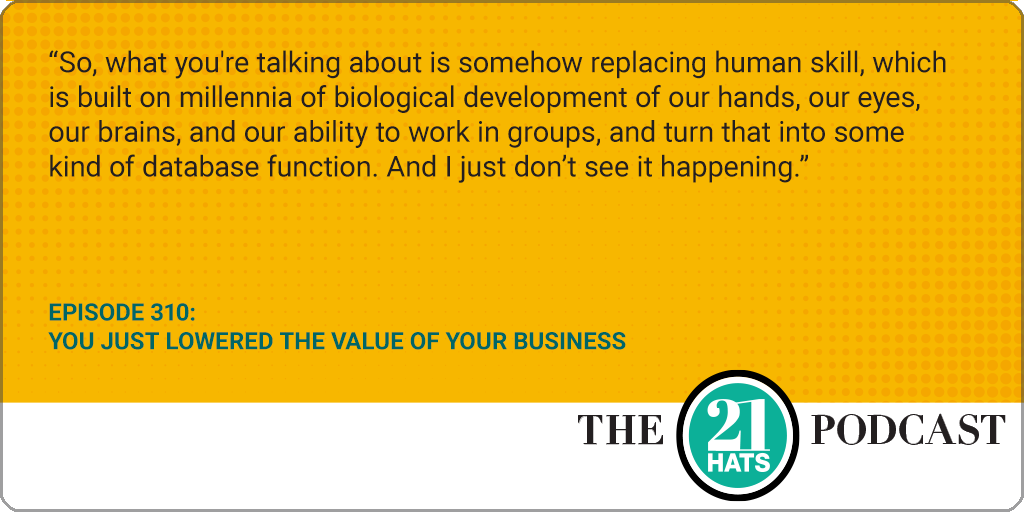
You Just Lowered the Value of Your Business: Earlier this year, Ted Wolf suggested that Paul Downs should take a serious look at how artificial intelligence might improve his custom woodworking business. Paul was skeptical—but he invited Ted and his team to come visit the shop and see for themselves. This week, Ted reports back. He came away impressed by the business Paul has built but also convinced that Paul has a problem: As Ted sees it, too much of what makes the company work still resides in Paul’s head. Ted believes AI could help capture some of that knowledge, improve everything from estimating to production, and, perhaps most important, prepare the company to run one day without Paul.
Paul remains unconvinced. He agrees that AI will find its way into the business eventually, but he questions whether it can capture the judgment, experience, and nuance required to build one-of-a-kind products. His inclination is to let the next owners figure that out. “So Paul,” Ted responds, “if they’re going to have to deal with it, you just lowered the value of your company.” Which raises a question that goes well beyond AI: If you hope someday to sell or transfer your business, how much of what you know has to be captured before you leave?
Plus: In our latest Beyond Small segment, sponsored by Grasshopper Bank, I ask Paul, Ted, and Lena McGuire what would happen if their businesses suddenly doubled. Would they be thrilled—or terrified? Could they handle the growth? Would they even want it? That leads to a discussion that comes up here fairly often: How big do you really want your business to be?
You can subscribe to the 21 Hats Podcast wherever you get podcasts.
