
Step One: Make a Plan
Lou Mosca sees business owners facing all kinds of challenges, every day. He offers three suggestions.

Good Morning!
Here are today’s highlights:
In some sectors, prices are actually falling.
After a cyberattack, car dealers are closing sales with pen and paper.
The window has just about closed on Employee Retention Credits.
In San Francisco, the owner of a coffee chain embraces the joy of having no investors.
MANAGEMENT
Lou Mosca is worried about you: “Very few of the 33 million business owners in the U.S. take in more than $1 million. The FTC has ruled non-compete agreements invalid. Thanks to the federal government, millions of salaried workers will be eligible for overtime pay on July 1. At American Management, we've met clients who have yet to have their PPP loans forgiven or are having trouble with EIDL payments. Independent business owners face many challenges, and if you’re facing issues like these, I have three suggestions for you. First, you need a plan. Second, you need to focus on maximizing profit. Third, you need to install an incentive plan to reward employees for achieving praiseworthy results.” CONNECT WITH LOU
PRICING
Frappuccinos are now half price at Starbucks: “After largely eschewing special deals for decades, the coffee at Starbucks is now often available at a discount. The world’s largest coffee chain is trying to bring back lapsed customers, betting big on BOGO offers, supersize perks for loyalty members and other deals. The company ran promotions for about half the month of May, according to documents viewed by The Wall Street Journal. This month, for the first time in more than a decade, Starbucks began offering bundles of coffee and breakfast food starting at $5.”
“Seattle-based Starbucks has long positioned itself as a premium brand—with prices to match. A single iced coffee with extra syrups and foams can cost about $10 at full price. The chain’s global expansion was powered in part by reimagining a commodity beverage as an aspirational treat for teens, office workers, and suburban moms. Surging inflation over the past several years is now spurring more Americans to rethink their spending on everything from food to furniture.”
“Many restaurant chains are pumping out new deals this year in a bid to try to reverse weak traffic. McDonald’s is set Tuesday to offer a $5 bundle deal for roughly a month. Burger King this month brought back its own $5 meal bundle. Even Shake Shack, which hasn’t traditionally had discounts, has started to run shake and chicken-sandwich deals.” READ MORE
Class-action lawsuits accuse landlords of price-fixing: “Several major apartment landlords from across the country are under fire over rental rates — allegations that have spawned a wave of class-action lawsuits and garnered the attention of state and federal authorities. The lawsuits have high-stakes for the apartment market and beyond, with potential to shape how pricing software could be utilized in multiple industries. At issue are dozens of large apartment-building owners and real estate companies using the services of software firm RealPage.”
“Landlords provided RealPage with internal data including occupancy rates, lease terms and rents charged for various units and floor plans in exchange for a RealPage algorithm that generates a price for the available units for each of the company's clients.”
“Critics, plaintiffs, and government officials claim that amounts to price-fixing, as RealPage in essence is setting the rental rates for the units, preventing landlords from competing with each other in the market.”
“In Phoenix, about 70 percent of the city's multifamily apartment units are owned, operated or managed by companies that have contracted with RealPage for revenue management — with 50 percent of the multifamily units in Tucson operating similarly, according to the Arizona complaint.” READ MORE
RETAIL
A cyber attack has thrown car dealers into turmoil: “Thousands of car dealers around the U.S. lost access for the second straight day to software that helps underpin their day-to-day operations, disrupting their ability to sell or repair cars. CDK Global, which provides the technology to auto dealers, said it experienced cyber incidents that first affected service to dealers on Wednesday. The company shut down most of its systems while it assesses the situation, a spokeswoman said.”
“The company provides nearly 15,000 dealers software to manage their sales, payroll and general office operations, according to the company’s website. Meanwhile, dealers were left to address the fallout, in some cases using pen and paper to record sales.
“Geoffrey Pohanka, chairman of Pohanka Automotive Group, said his company relies heavily on CDK for its day-to-day business operations. ‘They’re a very integrated company,’ Pohanka said. ‘It’s better for us to deal with one vendor than two dozen small vendors.’”
“Pohanka said his staff is manually completing the paperwork on sales and repair orders. Dealerships have workarounds and contingency plans for such potential scenarios, including if there is a power outage, he added. ‘The problem is, if this goes on for an extended period of time, it would be a very difficult situation,’ he said.” READ MORE
FINANCE
The IRS says it will deny most outstanding claims for Employee Retention Credits: “Congress created the tax credit in March 2020 to help businesses that kept paying employees after being shut down early in the pandemic. Despite narrow guidelines for what businesses could qualify for the credit, applications for the program have surged over the past three years, and the IRS stopped processing new claims in September. The agency will continue that moratorium. The IRS said Thursday it has investigated 1 million claims worth about $86 billion. The IRS plans to deny between 10 and 20 percent of the claims at greatest risk in the near future and will continue investigating another 60 to 70 percent of claims that show an ‘unacceptable level of risk,’ the agency said.”
“Business owners who filed legitimate claims can expect to receive their first payments later this summer, the IRS said. The payments will come at a dramatically slower rate than they did during the pandemic because of the program’s increased scrutiny.” READ MORE
In San Francisco, even coffee shop owners get pitched by investors: “Lauren Crabbe got her first business card from an investor around the time she and her husband opened up their third Andytown Coffee location. The interaction felt quintessentially SF, where it’s not uncommon to receive pitches about potential funding while handing over an espresso or discover that one of the regulars is a big-shot financier. ‘Those are the kinds of conversations you can have casually in San Francisco,’ Crabbe recalled with a laugh. ‘In any other city, you’d have to really seek it out.’”
“VCs typically back fast-growth tech startups, not cafes, but the simple proximity of investors to San Francisco’s historically high-quality coffee culture could explain the glut of funding that local caffeine peddlers have received over the years.”
“But the funding infusions aren’t universally celebrated. Gobs of cash or new management have spurred customer complaints ranging from declining coffee quality to a loss of charm. Most recently, coffee lovers have started wringing their hands over a former Starbucks exec taking the helm at Sightglass as the founders step down.”
“Despite a handful of investment pitches over the years, Andytown has expanded to six locations around the Bay Area without taking any of that funding. ‘We’re very proud of that—and of our scrappiness,’ Crabbe said.”
“For her, there’s a joy in not having to justify to an investor how her values play into how she runs Andytown. That spans major decisions on wages or staffing to minor ones, like keeping extra whipped cream free.” READ MORE
ENERGY
The Economist says solar power will change the world: “To call solar power’s rise exponential is not hyperbole, but a statement of fact. Installed solar capacity doubles roughly every three years, and so grows ten-fold each decade. Such sustained growth is seldom seen in anything that matters. That makes it hard for people to get their heads round what is going on. When it was a tenth of its current size 10 years ago, solar power was still seen as marginal even by experts who knew how fast it had grown. The next 10-fold increase will be equivalent to multiplying the world’s entire fleet of nuclear reactors by eight in less than the time it typically takes to build just a single one of them.”
“Solar cells will in all likelihood be the single biggest source of electrical power on the planet by the mid 2030s. By the 2040s they may be the largest source not just of electricity but of all energy. On current trends, the all-in cost of the electricity they produce promises to be less than half as expensive as the cheapest available today.”
“To grasp that this is not some environmentalist fever dream, consider solar economics. As the cumulative production of a manufactured good increases, costs go down. As costs go down, demand goes up. As demand goes up, production increases—and costs go down further. This cannot go on for ever; production, demand or both always become constrained. In earlier energy transitions—from wood to coal, coal to oil or oil to gas—the efficiency of extraction grew, but it was eventually offset by the cost of finding ever more fuel.”
“As our essay this week explains, solar power faces no such constraint. The resources needed to produce solar cells and plant them on solar farms are silicon-rich sand, sunny places, and human ingenuity, all three of which are abundant.” READ MORE
THE 21 HATS PODCAST
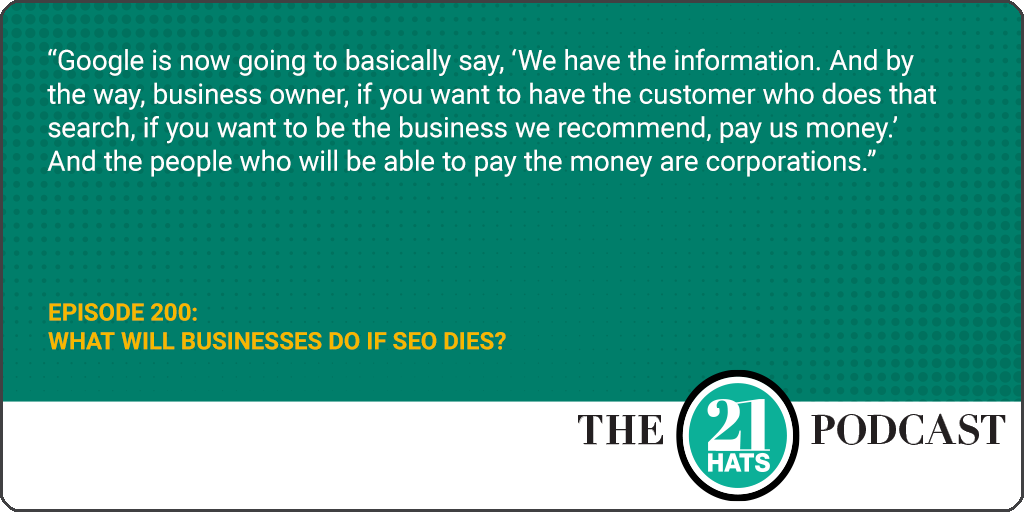
What Will Businesses Do if SEO Dies? This week, Shawn Busse, Liz Picarazzi, and Jaci Russo talk about how the marketing world is turning upside down. For decades, business owners have treated search engine optimization as something of a religion. They may not have been able to explain it, but they had faith that, if they obeyed the rules, Google would discover their sites and rank them. But search engines are getting a lot less generous about sharing links, and Shawn fears there’s an apocalypse coming for businesses that rely too heavily on SEO. Jaci’s a little more optimistic: “There'll be some other places to go get free traffic,” she says. “There always are.”
Plus: In a case study ripped right from the subreddit headlines, I ask the three owners: What do you do if a loyal, hard-working employee starts a side hustle selling a product that doesn’t compete with your product but looks a lot like it?
You can subscribe to the 21 Hats Podcast wherever you get podcasts.
Thanks for reading, everyone. — Loren